 | And Biodiversity
Overview
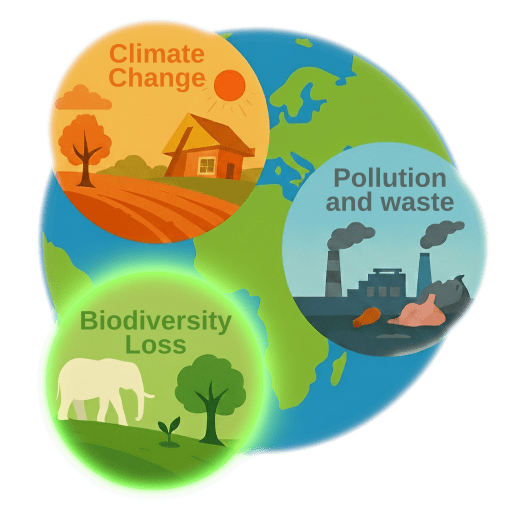
Learn more about biodiversity loss with a high level overview.


What is biodiversity loss?
The rapid, accelerating
loss of variability and abundance of life on Earth across the
hierarchies of genes, species, and ecosystems including: plant and
animal species; wild and domesticated varieties; and natural habitats
and biomes. Such loss has been caused by human activities with direct
drivers of land/sea use change, overexploitation of organisms, climate
change, pollution, and invasive alien species. See IPBES 2019
Global Assessment.

Who are affected by biodiversity loss?
Due to
reliance on biodiversity for food supply, air quality, water supply,
climate regulation, and other ecosystem services, all flora and fauna
including humans are affected by this crisis. See IPBES-IPCC
co-sponsored 2021 report.

Where does biodiversity loss occur?
While
disappearing species and damaged ecosystems vary by regions and biomes,
consistent evidence indicates a global scale to biodiversity loss.
See World Wildlife Fund’s Living Planet biennual reports.

When did biodiversity loss start?
Since the
Industrial Revolution and notably mid-20th century with the rapid rise
of human population, global trade, industrial farming and fishing, and
expansive urbanization, biodiversity loss has occurred at unprecedented
levels in human history with signs of acceleration. See all
biodiversity global assessments from 1995, 2005, and 2019.

Why is biodiversity loss important?
For
life-critical services, environmental, economic, developmental, ethical,
security, and social issues, biodiversity loss plays an instrumental
role from food webs to GDP accounting. See the Dasgupta Review
in 2021 on The Economics of Biodiversity.

How can we stop biodiversity loss?
Raise awareness.
Start discussions. Adjust lifestyle and diet. Avoid waste and excessive
consumption. Boycott goods, services, and industries that destroy
nature. Advocate for the end to forest logging, wetland draining, and
other actions. Implore public and business leaders. Exercise consumer
and voting power. Insist on sustainable spatial planning with nature.
See recommendations in most reports and papers.

When were key global moments regarding biodiversity loss?
- United Nations Conference on the Human Environment convened in Stockholm, Sweden leads to formation of UN Environment Programme (UNEP) that would oversee among other global environment issues: climate change and biodiversity. See UNEP history.
- UNEP environment reports recognize species diversity and ecosystems. See Reports.
- States adopt the Convention on International Trade in Endangered Species of Wild Fauna and Flora (CITES), an international conservation effort to protect the planet’s most endangered species. See UNEP history.


- Scientific papers and books begin to formally use the term, biological diversity, and its contraction, biodiversity.
- UN publishes the landmark World Commission on Sustainable Developments Bruntland Report, Our Common Future, to guide sustainable development in the face of environmental challenges. See Reports.
- The Intergovernmental Panel on Climate Change (IPCC) launches to formalize the intergovernmental science-policy interface.


- Convention on Biological Diversity (CBD) opens for signature at the Rio Earth Summit along with UNFCCC and enters into full force a year later as an intergovernmental agreement. See CBD history.
- WCMC publishes the most comprehensive review of global biodiversity ever compiled, Global Biodiversity: Status of the Earth’s living resources. See Reports.
- UNEP publishes the first global biodiversity assessment, the work of over 1,500 scientists and experts from all parts of the world, to provide a snapshot of the current state of the biodiversity sciences and of the subject as perceived by the world’s scientific community. See press release.


- UN commits to achieve the Millennium Development Goals which specifically includes biodiversity loss under target 7 for environmental sustainability. See UNEP history.
- The landmark Millennium Ecosystem Assessment (MEA) publishes its findings on the consequences of ecosystem change for human well-being which involved the work of more than 1,300 experts worldwide from 2001-2005. See press release.
- Research team lead by Johan Rockström and Will Steffen publish the Planetary Boundaries Framework that recognizes biodiversity as one of the transgressed boundaries. See Stockholm Resilience Center research.


- Conference of the Parties to the Convention on Biological Diversity (CBD) at its tenth meeting (COP10) in Aichi, Japan agree to the Aichi 20 biodiversity targets to be achieved by 2020. See targets.
- Intergovernmental Science-Policy Platform on Biodiversity and Ecosystem Services (IPBES) launches as an independent, intergovernmental body to serve as a science-policy interface. See IPBES history.
- IPBES publishes its landmark, comprehensive Global Assessment to assess the status and trends of biodiversity and ecosystem services over past five decades, its impact on human wellbeing, and the effectiveness of responses. See media release.


- IPBES and IPCC launches their first-ever collaboration with a workshop report of selected authors, stressing the interlinked nature of climate change and biodiversity loss. See Reports.
- UN launches the Decade on Ecosystem Restoration, the global movement to assist in the recovery of ecosystems that have been degraded or destroyed, as well as conserving intact ecosystems. See website.
- Conference of the Parties to the Convention on Biological Diversity (CBD) at COP15 adopt global targets by 2030 in landmark biodiversity agreement. See press release.


What are proposed solutions?
- Rewild with herbivores and carnivores to systems where they have been lost. See IPBES-IPCC joint report.
- Manage and restore natural and modified ecosystems. See IPBES-IPCC joint report.
- Rebuild terrestrial and marine carbon stocks. See IPBES-IPCC joint report.
- Rebuild overexploited or depleted fish stocks. See IPBES-IPCC joint report.
- Intervene at the watershed or river basin scale. See UNEP blueprint report.
- … See most reports.
- Agroecological practices such as increasing crop and livestock diversity including by using varietal mixes, more complex crop rotations, intercropping, wild relatives for crop and livestock selection, on-farm crop selection, and integrated farming. See IPBES-IPCC joint report.
- Agroforestry including mixing trees with crops. See IPBES-IPCC joint report.
- Sustainable fisheries to avoid overfishing. See IPBES-IPCC joint report.
- Sustainable agriculture to reduce pesticide use and nitrogen and phosphorus imbalances. See UNEP blueprint report.
- Sustainable urban planning; encouraging densification for compact communities, especially in sprawling cities. See UNEP blueprint report.
- … See most reports.
- Eliminate subsidies harmful to biodiversity. See IPBES Global Assessment.
- Include nature capital in national accounts. See Dasgupta Review, IPBES values, and OECD reports.
- Promote private sector financing for biodiversity. See Dasgupta Review.
- Utilize Payments for Ecosystem Services (PES). See Dasgupta Review.
- Integrate the protection of biodiversity with the fiduciary duties of institutional investors and asset managers. See Dasgupta Review.
- … See most reports.

Dasgupta Review - Figure 3
- Decarbonize the energy system. See IPCC reports.
- Localize the food supply chain. See IPBES-IPCC joint report.
- Promote resource efficiency, circular, and other ecological economic models. See IPBES Global Assessment.
- Innovate new business models to reduce global and local chemical pollution. See UNEP blueprint report.
- Mainstream biodiversity in global financial system. See Dasgupta Review.
- … See most reports.

UNEP Making Peace with Nature - Fig 6.3
- Build multifunctional land- and seascapes. See IPBES-IPCC joint report.
- Establish well-connected protected areas. See IPBES-IPCC joint report.
- Manage invasive species encroachment. See IPBES-IPCC joint report.
- Plan for transboundary conservation. See IPBES Global Assessment.
- Mainstream biodiversity in landscape planning. See IPBES-IPCC joint report.
- … See most reports.

IPBES-IPCC Report - Figure 2.2
- Adopt integrative, inclusive, informed, and adaptive governance. See IPBES Global Assessment.
- Implement polycentric and layered institutions. See Dasgupta Review.
- Advance science-policy processes to generate actions needed to address more complex problems such as climate change and biodiversity loss. See UNEP blueprint report.
- Empower citizens with informed consumer decision-making. See Dasgupta Review.
- Mainstream biodiversity in policymaking. See IPBES Global Assessment.
- … See most reports.

Dasgupta Review - Figure 21
What, where, how are real-world examples?
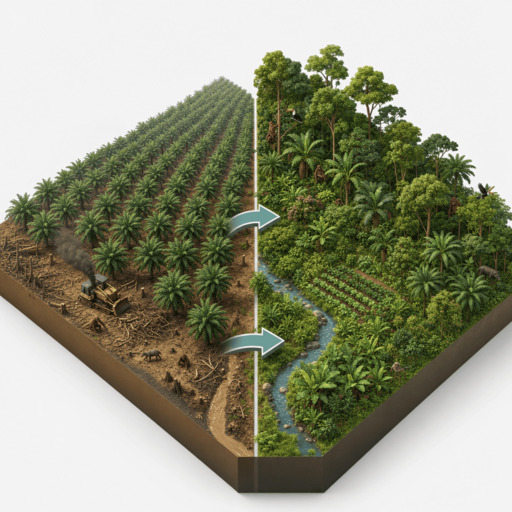
Problems: Conversion of hyper-biodiverse primary forests and savannas into zero-structural-diversity crop deserts; Severe fragmentation of vital migratory corridors for endangered key megafauna; Extensive clearing that allows opportunistic, invasive edge-species to displace native flora.
Solutions: Agroforestry integration and the establishment of wide, contiguous wildlife corridors; Legally binding High Conservation Value (HCV) protections that prohibit clearing intact biomes; Satellite-verified zero-deforestation supply chain tracking frameworks.
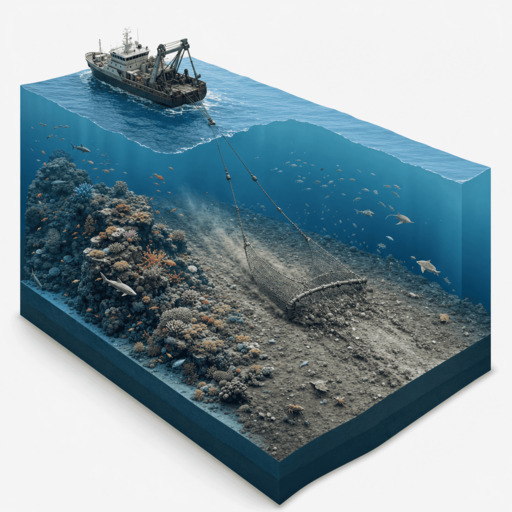
Problems: Physical obliteration of slow-growing benthic ecosystems, deep-sea coral reefs, and seamounts; Massive, unselective bycatch of non-target marine species, accelerating the collapse of the 33% of fish stocks currently harvested at unsustainable levels; Severe disruption of deep ocean carbon-sink sediments.
Solutions: Establishment of large-scale, fully protected No-Take Marine Protected Areas (MPAs); Mandatory deployment of selective gear technologies like turtle excluder devices and smart-nets; Global enforcement of bans on bottom-trawling across Vulnerable Marine Ecosystems (VMEs).

Problems: Destruction of coastal mangrove forests, removing critical nurseries for wild fish and stripping storm protection from 100-300 million coastal residents; Concentrated nutrient pollution from uneaten feed and feces, resulting in localized anoxic (oxygen-depleted) dead zones; Frequent escapes of non-native farmed strains that outcompete or spread virulent diseases to fragile wild populations.
Solutions: Transitioning to recirculating, land-based closed-containment aquaculture systems; Restorative aquasilviculture models that integrate active mangrove restoration directly into low-density farming; Multi-trophic aquaculture layouts that utilize seaweed and bivalves to naturally filter and recycle waste nutrients.
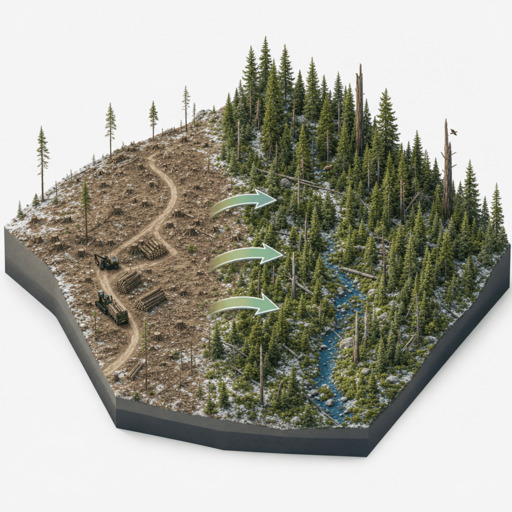
Problems: Clear-cutting complex, uneven-aged old-growth forests, which permanently eliminates unique vertical micro-habitats; Loss of specialized, canopy-dependent bird and lichen species that cannot survive in young, even-aged replanted stands; Carving heavy logging roads into intact wilderness, which catalyzes secondary degradation and wildlife poaching.
Solutions: Adoption of Continuous Cover Forestry (CCF) paradigms that rely on single-tree or small-group selective extraction; Mandatory retention of standing deadwood (snags) and large biological legacy trees to sustain cavity-nesters; Immediate ecological decommissioning and re-vegetation of access roads post-harvest.
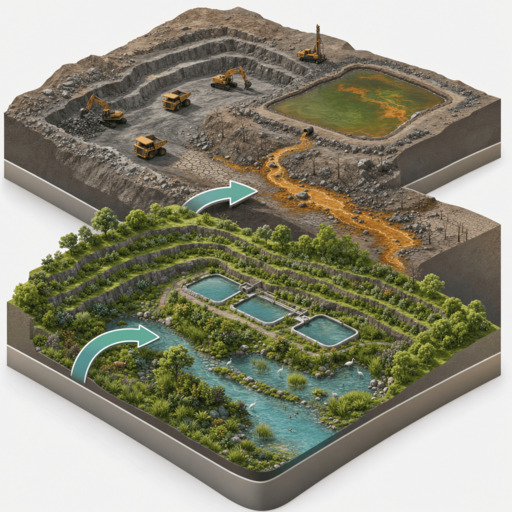
Problems: Complete strip-mining of unique, hyper-localized ecosystems found exclusively on mineral-rich crags or salt flats; Severe groundwater depletion and heavy metal contamination of surrounding freshwater networks, devastating endemic aquatic life; Acid mine drainage that creates long-lasting toxic dead zones downstream.
Solutions: Strict implementation of closed-loop water recycling systems that prevent toxic tailings discharge; Mandatory, upfront financial bonds dedicated entirely to continuous, post-mining bioremediation and re-wilding; Scaling global secondary e-waste recycling infrastructures to drastically reduce the demand for primary frontier mining.
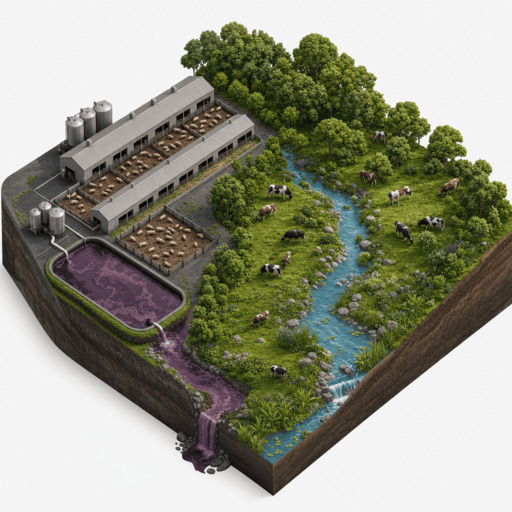
Problems: Driving massive indirect land use changes by devoting over one-third of global cropland purely to intensive livestock feed production; Enormous concentrated nitrogen and phosphorus runoff from mismanaged manure lagoons into watersheds; Directly fueling downstream agricultural runoff that contributes to the 400+ global oceanic dead zones.
Solutions: Systemic transition toward rotational, low-density silvopasture systems that integrate trees and pasture; Enforcing strict circular nutrient loops where manure is safely processed into regional bio-fertilizers, capping synthetic chemical applications; Substituting traditional feed crops with low-impact alternatives like insect-meal or methane-reducing seaweed.
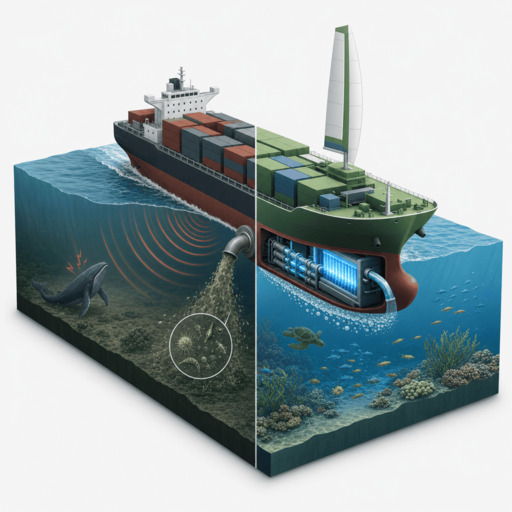
Problems: Unregulated or poorly treated ballast water discharge introducing aggressive invasive alien species into vulnerable port ecosystems; High-intensity underwater acoustic pollution that severely disrupts navigating, mating, and feeding behaviors of marine mammals; Localized ocean acidification concentrated along major shipping channels due to heavy sulfur and carbon exhaust emissions.
Solutions: Mandatory installation of advanced, multi-stage filtration and UV ballast water treatment systems on all transoceanic ships; Enforcing strict vessel speed reductions (‘slow-steaming’) and retrofitting fleets with quiet-propeller and air-lubrication hull technologies; Transitioning global shipping lanes to green hydrogen, ammonia, or wind-assisted propulsion systems.
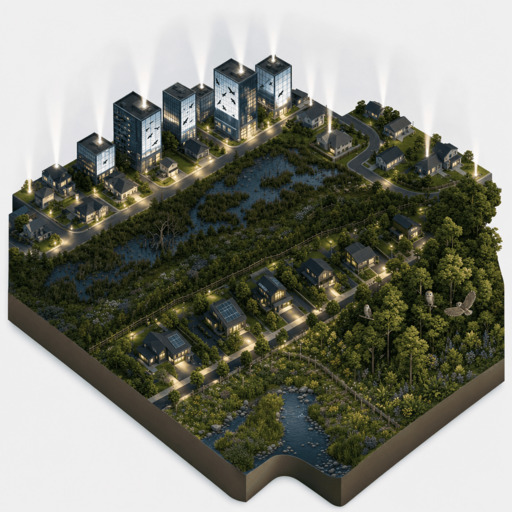
Problems: Encroaching directly onto wild perimeters (contributing to urban land areas more than doubling since 1992), replacing complex wetlands and woods with asphalt; Massive localized mortality events caused by reflective glass building collisions and intense artificial light pollution; Escaped ornamental garden plants and domestic pets acting as highly destructive invasive predators and competitors in adjacent wildlands.
Solutions: Establishing permanent, legally binding urban growth boundaries to protect peripheral biodiversity hotspots; Mandating bird-safe architectural glass designs and structural dark-sky outdoor lighting ordinances; Enforcing municipal landscaping mandates that restrict public spaces to native flora and encourage urban pocket forests.

Problems: Providing the underlying capital, equity, and underwriting that finances nature-negative global operations and infrastructure expansion; A systemic lack of nature-risk valuation in standard corporate accounting, rendering the true ecological cost of corporate profits invisible; Failing to filter out investments that drive habitat loss or overexploitation because biodiversity metrics are omitted from standard risk profiles.
Solutions: Universal, mandatory implementation of the Taskforce on Nature-related Financial Disclosures (TNFD) framework for all large institutions; Full divestment from asset classes tied to primary forest clearing, illegal fishing, or unmitigated industrial pollution; Deploying innovative financial vehicles like biodiversity credits and debt-for-nature swaps aligned directly with the Global Biodiversity Framework.
Why And Biodiversity? To analyze solutions:
|
|
Agro-
|
|
Wildlife
|
|
Aqua-
|
|
Coastal
|
|
De-
|
|
|
Pest
|
|
Local
|
|
Wetland
|
|
Trophic
|
|
Agro-
|