 | And Biodiversity
Ecoregions
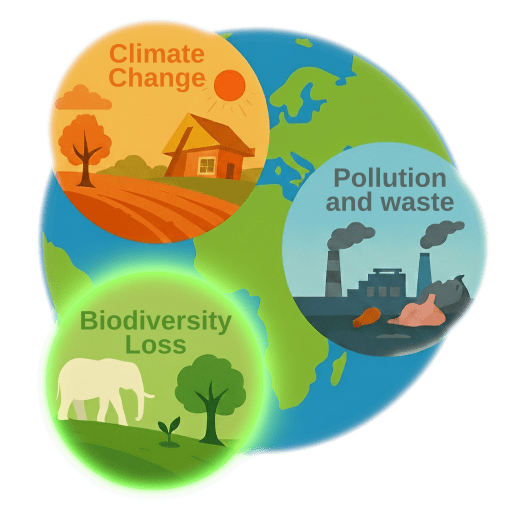
From Edward O. Wilson, world-renowned natural scientist and pioneer in efforts to preserve and protect global biodiversity:
There are three levels of biodiversity that we’re trying to save: ecosystems, then the species in the ecosystems, and then the genes that prescribe traits of the species that make up the ecosystem…
Explore here the OneEarth ecoregions and IUCN Global Ecosystem Typology and their cited local human pressures.


AA
OneEarth Ecoregions
Australasia
AN
OneEarth Ecoregions
Antarctica
AT
OneEarth Ecoregions
Afrotropics
CA
OneEarth Ecoregions
Central America & Caribbean
CE
OneEarth Ecoregions
Central Eurasia
EE
OneEarth Ecoregions
Eastern Eurasia
IN
OneEarth Ecoregions
Indomalaya
NA
OneEarth Ecoregions
Northern America
OC
OneEarth Ecoregions
Oceania
SA
OneEarth Ecoregions
Southern America
SCA
OneEarth Ecoregions
Subarctic America
SCE
OneEarth Ecoregions
Subarctic Eurasia
SE
OneEarth Ecoregions
Southern Eurasia
WE
OneEarth Ecoregions
Western Eurasia
New!
F
IUCN Global Ecosystem Typology
Freshwater
FM
IUCN Global Ecosystem Typology
Freshwater-Marine
M
IUCN Global Ecosystem Typology
Marine
MFT
IUCN Global Ecosystem Typology
Marine-Freshwater-Terrestrial
MT
IUCN Global Ecosystem Typology
Marine-Terrestrial
S
IUCN Global Ecosystem Typology
Subterranean
SF
IUCN Global Ecosystem Typology
Subterranean-Freshwater
SM
IUCN Global Ecosystem Typology
Subterranean-Marine
T
IUCN Global Ecosystem Typology
Terrestrial
TF
IUCN Global Ecosystem Typology
Terrestrial-Freshwater
Citations
One Earth Bioregions Framework, One Earth. {2023} Los Angeles, CA. https://www.oneearth.org/bioregions-2023/
Keith, D. A., J. R. Ferrer-Paris, E. Nicholson, M. Bishop, B. A, Polidoro, E. Ramirez-Llodra, M. G. Tozer, J. L. Nel, R. Mac Nally, E. J. Gregr, K. E. Watermeyer, F. Essl, D. Faber-Langendoen, J. Franklin, C. E. R. Lehmann, A. Etter, D. J. Roux, J. S. Stark, J. A. Rowland, N. A. Brummitt, U. C. Fernandez-Arcaya, I. M. Suthers, S. K. Wiser, I. Donohue, L. J. Jackson, R. T. Pennington, N. Pettorelli, A. Andrade, A. Lindgaard, T. Tahvanainen, A. Terauds, M. A. Chadwick, N. J. Murray, J. Moat, P. Pliscoff, I. Zager, and R. T. Kingsford (2022) A function-based typology for Earth’s ecosystems Nature 610, 513–518. DOI:10.1038/s41586-022-05318-4. Online at https://global-ecosystems.org/
Why And Biodiversity? To learn of transformative change:
|
|
Agroforestry |
|
Cultural
|
|
Knowledge
|
|
Education
|
|
Strategic
|
|
|
Push-pull
|
|
Community
|
|
Social
|
|
Nature
|
|
Divese
|